
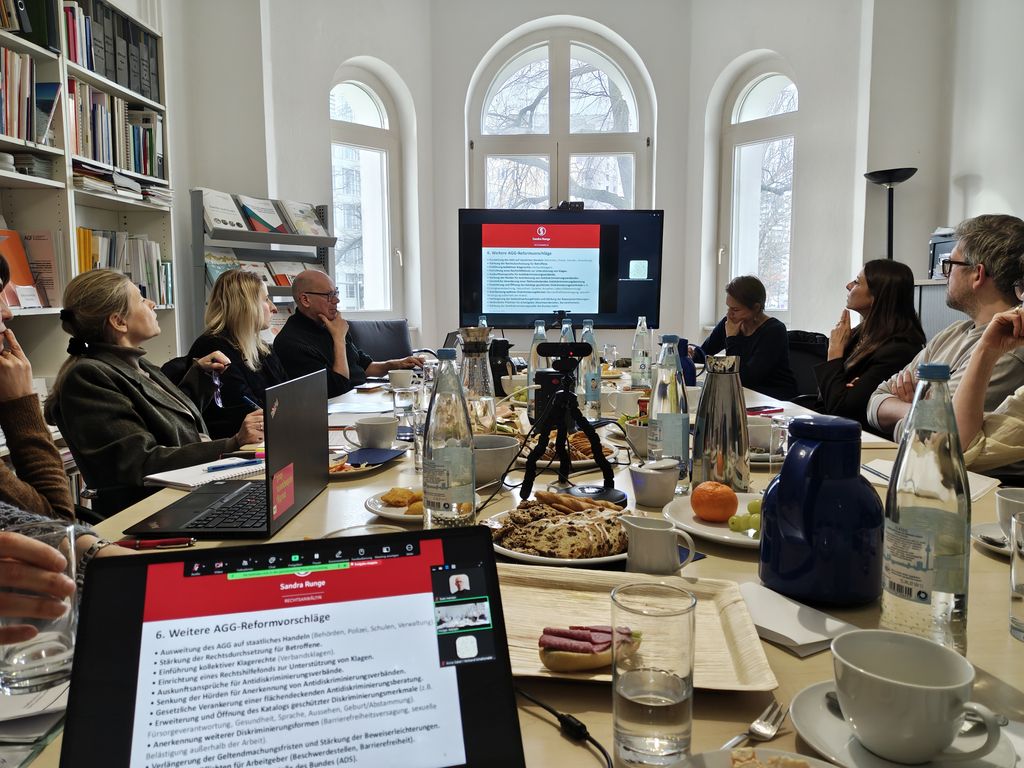
On December 11, 2025, an AGF expert discussion was held on the potenitals of the german General Equal Treatment Act (AGG) for protecting families from discrimination – and the opportunities that a future reform could offer to better identify and prevent family-specific discrimination. The guest speaker was Sandra Runge, a specialist lawyer for labor law and co-founder of the #ProParents initiative. In her expert input, she provided insights into her legal practice, presented current findings from studies on discrimination against people with care responsibilities, and classified these from a legal perspective. The participants then discussed the significance of the AGG from the perspective of family associations today, its limitations, and how further developments could improve the situation of people with care responsibilities.
Discrimination against parents is an everyday occurrence, not an exception
At the beginning of her presentation, Sandra Runge highlighted that discrimination is part of everyday working life for many parents. Studies by the Federal Anti-Discrimination Agency, as well as her experience as a labor lawyer, showed that a large proportion of parents experience discrimination in the course of their working lives—especially in connection with pregnancy, parental leave, or returning to work. Single parents, parents with fixed-term employment contracts, parents with low incomes, and mothers working part-time are particularly affected.
Concrete examples from legal practice clearly illustrate the many ways in which such discrimination can manifest itself: inappropriate questions about plans to have children during job interviews, disadvantages in promotions, lack of salary increases, or non-renewal of employment contracts around the time of parental leave. Many of these experiences are perceived by those affected as “individual bad luck” – and are rarely reviewed from a legal perspective.
Applicable law reaches its limits
A central point of the discussion was the question to what extent parents are currently protected by law. There are individual protective regulations in the form of the Maternity Protection Act, the Federal Parental Allowance and Parental Leave Act, and the Unfair Dismissal Protection Act. However, these only apply in certain phases in family life and do not include comprehensive protection against discrimination throughout the entire course of a person’s working life.
Family care responsibilities as a new characteristic of discrimination
The AGG, on the other hand, currently only protects against discrimination based on the explicitly mentioned characteristics: race/ethnic origin, gender, religion/belief, disability, age, and sexual identity. Parenthood or family care responsibilities are not included. Discrimination against parents can therefore often only be asserted indirectly – for example, on the basis of gender or indirect discrimination. Therefore, according to Ms. Runge, there are considerable gaps in protection, particularly for fathers and for discrimination after parental leave.
Against this background, Sandra Runge presented the core demand of the #ProParents initiative: the inclusion of parenthood or family care responsibilities as an independent characteristic of discrimination in the AGG. Such an extension would make it possible to identify discrimination more clearly and pursue it more effectively in court, regardless of gender. At the same time, it could help to make employers more accountable and promote preventive, non-discriminatory, family-friendly working conditions. Reporting requirements for companies in the area of discrimination protection and equal treatment could also contribute to this. Such obligations could make the risks for discrimination more systematically visible. This would enable supporting persons within companies – such as human resources managers or interest groups – to be better supported in actively promoting non-discriminatory and family-friendly structures.
Additional far-reaching reform ideas were discussed in the meeting, such as extending the AGG to government action, providing better support for those affected, or strengthening collective legal action. Furthermore, the expert discussion made highlighted, that the lack of protection in the sensitive phase after parental leave is a central structural problem. Dismissals immediately after the end of parental leave are not an exception, but rather an expression of a gap in protection in current law. Extending particular protection against dismissal beyond the end of parental leave was therefore discussed as an important approach to effectively protect parents that return to work and to prevent discrimination preventively rather than retrospectively.
Exchange and open questions from the perspective of family associations
In the ensuing discussion, it became clear that discrimination against families affects many areas of life, but that the world of work plays a particularly important role. Discrimination often has long-term effects here – on income, employment history, and social security. At the same time, it became apparent that the AGG so far has played only a small role in the family policy debate and that, from the perspective of family associations, its potential has hardly been systematically explored.
The expert discussion was linked to earlier AGF discussions, for example on discrimination against families in the housing market, and broadened the focus to other areas of life.