
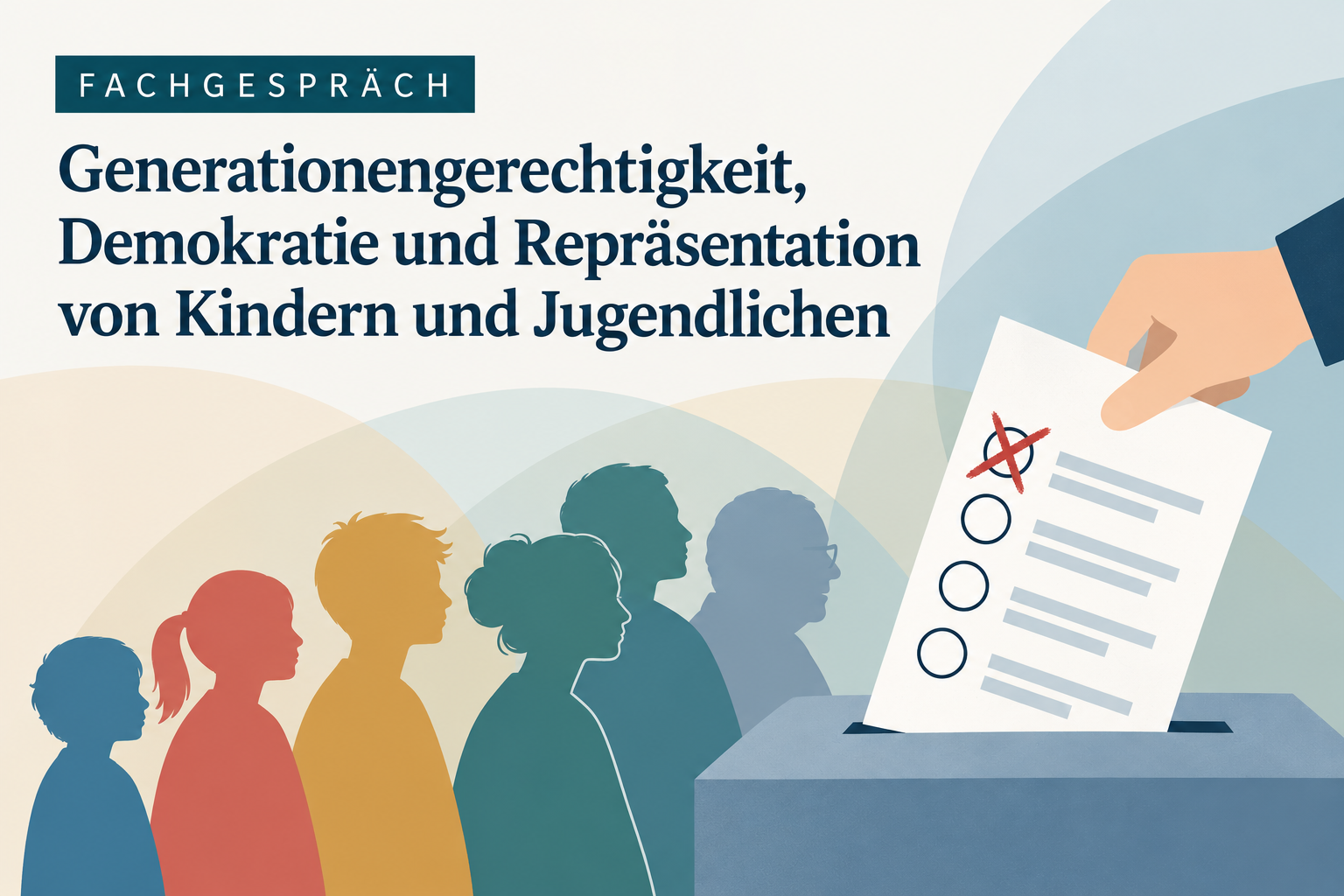
How can children and young people be better represented in our democracy? The AGF discussed this issue at its expert roundtable on ‘Intergenerational Justice, Democracy and the Representation of Children and Young People’ with its member organisations, as well as representatives from the Foundation for the Rights of Future Generations, the German Children’s Fund (Deutsches Kinderhilfswerk), the German League for Children (Deutsche Liga für das Kind), the national network for the implementation of the UN Convention on the Rights of the Child in Germany and UNICEF.
The focus was on how demographic change affects political representation and the consideration of the interests of different generations. Whilst the proportion of older people in the electorate is growing, the relative weight of young people and families with children under the age of 18 is declining. The discussion therefore centred on the measures and democratic reforms that could be used to counteract this structural imbalance. Extending the right to vote to children and young people could be one way of mitigating the consequences of demographic change for political representation and giving greater weight to the interests of young people. Intergenerational justice is thus not only a question of the distribution of resources, but also a question of political representation, participation and power.
In their keynote address, Antonia Keis and Johannes Preyß from the Foundation for the Rights of Future Generations (SRzG) focused on the call for greater democratic inclusion of children and young people. To this end, the SRzG proposes a “right to vote by registration” with no fixed age limit: those under 16 should be able to register themselves on the electoral roll as soon as they wish to vote; 16- and 17-year-olds should automatically receive a polling card. The foundation, however, rejects the idea of parents casting votes on their children’s behalf.
In the ensuing discussion, there was agreement that the demographic shift within the electorate has political consequences: the interests of children and young people, families with children and future generations risk being given less weight compared with the interests of the numerically more numerous older generations. A series of measures is therefore needed to incorporate the interests of children and young people more effectively into political decision-making processes.
This involves various structures and procedures; a change to the electoral law could be an important building block in this regard, helping to better balance political representation across the generations. There were differing views on the specific details of how such a change to the electoral law might be shaped. Discussions centred on both the right to vote exercised directly by children and young people themselves, and models in which parents exercise the right to vote on behalf of younger children. From the perspective of some participants, a key argument in favour of the latter is the greater immediate impact it would have on the composition of the electorate. At the same time, fundamental objections were discussed – such as the question of the personal nature of the vote and whether parents would actually represent their children’s interests rather than their own political preferences. There was broad agreement that the voting age for federal parliamentary elections should be lowered.
Another approach discussed was strengthening the structural representation of children and young people. Both structural and ad hoc participation procedures, as well as children’s and young people’s advisory councils, were generally viewed positively. At the same time, the discussion revealed that their actual scope for influence currently varies considerably. Furthermore, the question arises as to how representative such bodies are of the diversity of the children and young people whose interests they are intended to represent.